

Nobody tells you that on day three, you'll realize nothing else is coming.
That's what happened to me. I walked into my first ESL teaching situation with a homophones bingo game, a shared library space, and two other teachers doing small groups in the same room. By the third day I figured out that nobody was going to hand me a curriculum. Admin was busy. ESL wasn't a priority. I was on my own.
If you're starting a secondary ESL class with no curriculum, no textbook, and no roadmap, this post is for you. Here's exactly what to do.
First, Understand Why This Keeps Happening
Most districts simply don't have a curriculum set up for secondary ESL classrooms. Secondary ESL is almost always treated as a "special population" class, which means it gets deprioritized when districts are building out curriculum resources. You are probably the only ESL teacher in your building, maybe even your district. Admin is stretched thin and ESL curriculum for grades 6–12 is genuinely hard to find.
Understanding this upfront helps. Once you stop waiting for something to arrive and start building what you need, things get a lot easier.
Start With Your Students, Not Your Content
Your first week has one job: get to know your students. Don’t assess them with a formal test. Actually get to know them.
Come in on day one with activities that get students talking and writing informally. If you have a small group, sit in a circle and ask each other questions. Use conversation games: cards, a beach ball they toss around while answering questions, anything that feels low-stakes and a little fun. The goal is to get them speaking naturally so you can start evaluating their oral language without them realizing that's what you're doing.
At the same time, give them something informal to write. Ask them to tell you what you need to know about them to help them learn. What do they like? What do they not like? What are they good at? What's hard for them? Let them know it's private, just for you, so they can be honest. You'll learn more from that one writing sample than from any placement test.
This does two things at once: it builds trust and it gives you real data on where each student is in both speaking and writing.
Get Yourself Organized Before You Try to Organize Your Classroom
Before you start building routines for your students, get your own systems in order. Sit down and make a list of every single thing you have to do as a teacher: daily, weekly, monthly, and quarterly. Don't skip anything. Sub plans, grades, parent contact, progress monitoring, all of it.
Then take that list into Google Calendar and assign each task to a recurring time slot. Daily tasks get daily reminders. Weekly tasks get a weekly slot. For me, Fridays were my planning and copying day. I could not leave until my copies were made and my plans for Monday were done. If something big was coming up, I started earlier in the week. The rule was simple: everything that needed to happen on Friday got done before I left on Friday.
This sounds basic but it's the thing that kept me sane. When the calendar reminder popped up, I knew exactly what to do. I wasn't starting from scratch every week trying to figure out what was urgent.
Plan With the End in Mind
Once you're organized, start planning in units rather than individual lessons. Pick a timeframe: a month, two weeks, whatever feels manageable, and ask yourself: by the end of this unit, what do I want my students to know and be able to do? Write that down first. Then work backwards to fill in your weeks and days.
Project-based learning works especially well in secondary ESL because one project covers multiple skills at once. A good PBL unit gives you reading, writing, speaking, research, and critical thinking all in one package, and students have to actually think about the material instead of copying and filling in blanks. One or two weeks per project means your planning stays manageable while your students are getting deep, meaningful language practice.
If you're looking for a ready-made curriculum so you're not building everything from scratch, the ESL Teacher Membership has everything mapped out for you — units, activities, bell ringers, and more, all designed specifically for secondary ESL.
Build Your Classroom Routines Slowly and on Purpose
A well-managed secondary ESL classroom doesn't happen on day one. You build it piece by piece, teaching one routine at a time.
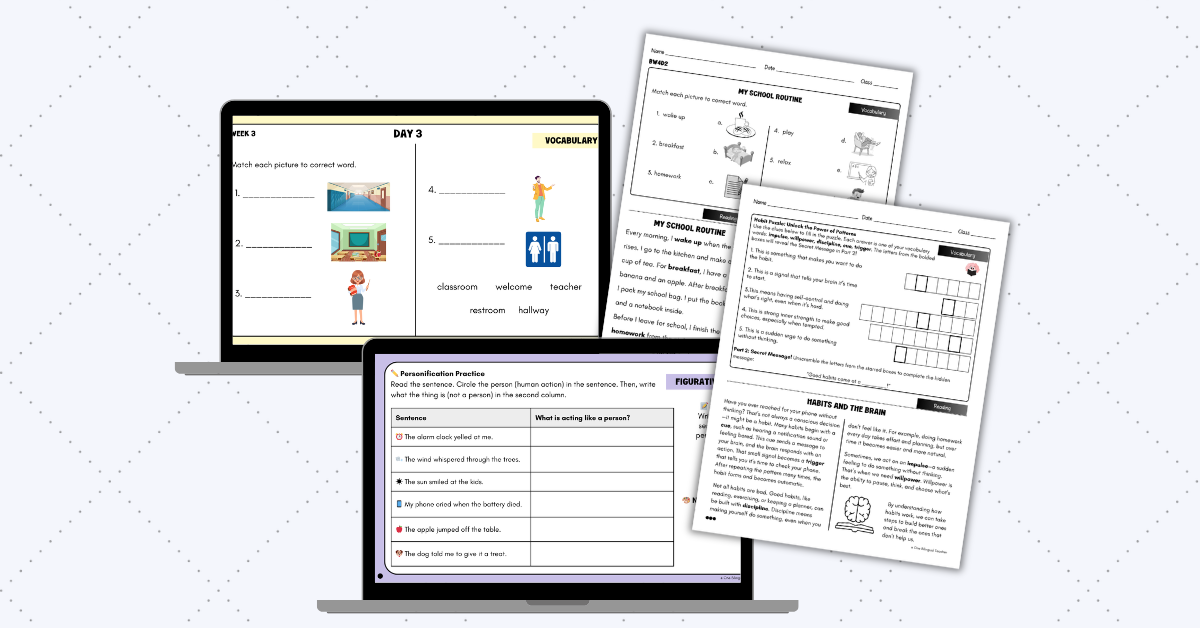
Start with the bell ringer. When students walk in, there's something on the board and they sit down and start working. That's it. Don't add anything else until that routine is solid. Then add the mini lesson. Then the exit ticket. By week two or three, you can start introducing stations or small group rotations, but only after the basics are automatic.
The reason this matters in a secondary ESL classroom specifically is language. Your students may not understand your directions, especially early in the year. That means your routines need to be simple enough that students can follow them with minimal verbal explanation. Keep directions short. Use gestures. Show rather than tell whenever possible. The more words you use, the more you lose them.
Manage Mixed Proficiency Levels With Intentional Grouping
Mixed proficiency levels are the reality of almost every secondary ESL classroom. The way you manage it comes down to how you group students.
Use small groups based on language proficiency for direct instruction. That's where you can target specific skills at the right level. For collaborative work, pair a beginner with an intermediate, or an intermediate with an advanced student. Students learn a lot of language from each other, and the more proficient student reinforces their own skills by explaining and modeling.
Keep rotating the pairings. Groups that stay the same too long go stagnant. Changing them up keeps students engaged and gives everyone a chance to work with different language models.
The Two Things Worth Building Your Whole Year Around
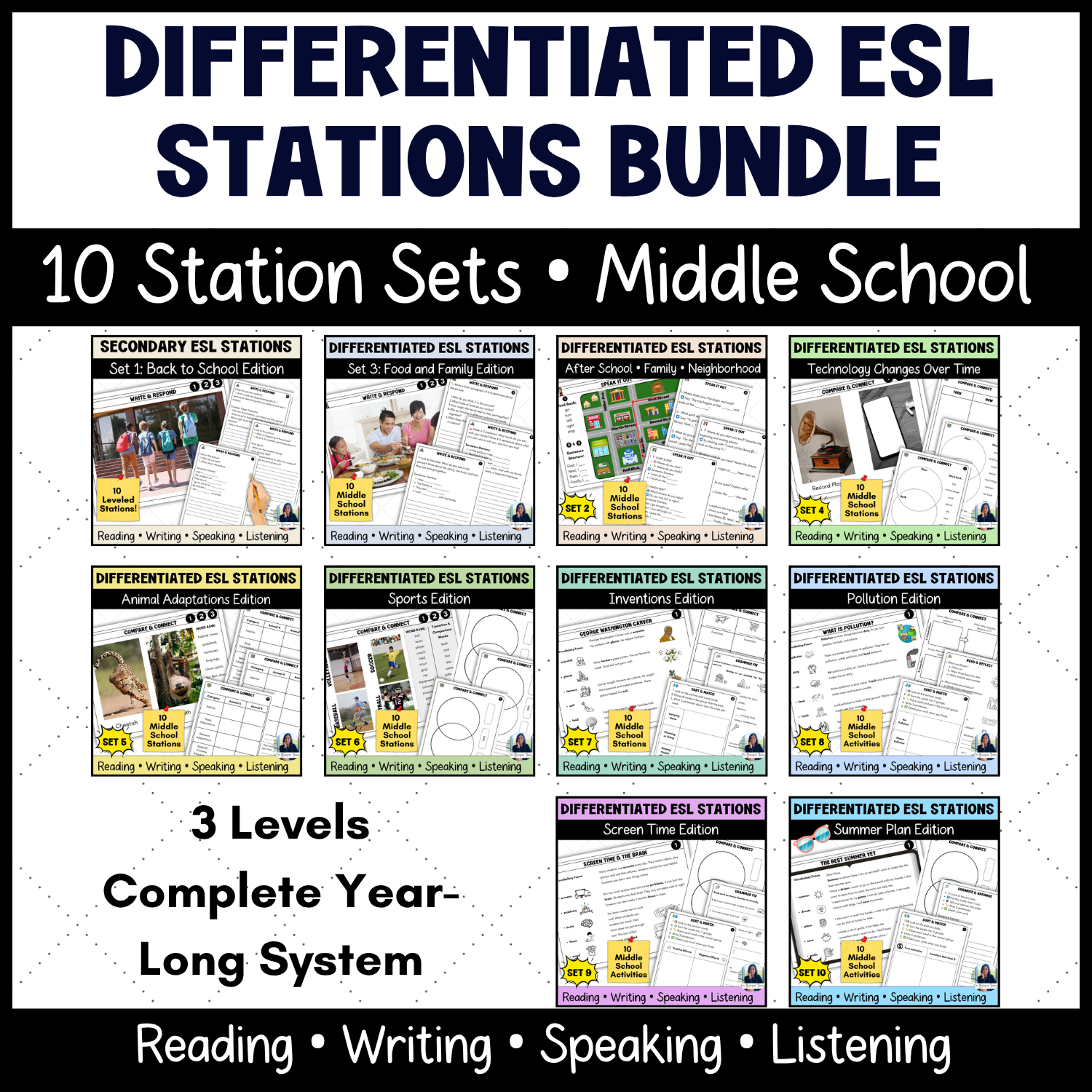
If I had to pick the two things I'd never teach secondary ESL without, it would be stations and small group instruction.
Stations let students rotate through independent activities with clear expectations while you work with one group at a time. The key is teaching the accountability piece. Students need to know exactly what they're doing at each station and what "done" looks like. Once that routine is in place, stations basically run themselves and you get uninterrupted time with the students who need you most.
Small group is where the real teaching happens. When you're sitting right in front of three or four students, they pay attention. They can't hide. And you actually get to connect with them as people, which matters more than almost anything else in a secondary ESL classroom.
One More Thing: Find Your People
Being an ESL teacher in a secondary school is lonely. You're probably the only one in your building, maybe in your district. Find your community before you burn out looking for it.
Join Facebook groups for secondary ESL teachers. Look for people in your district who work with ELL students even if their role is different. Connect with other teachers online who are doing exactly what you're doing. The people who get it are out there. You just have to find them.
You don't have to figure this out alone.