
7 Writing Activities for ESL Students That Build Real Skills
If you’re reading this, you’re probably sitting at your computer right now trying to figure out how to get your ESL students to write in English. You’re searching for some kind of magic formula or some activity that’s going to solve all of it. Because your students are so far behind, and you don’t know how to close that gap. You feel frustrated, overwhelmed, and honestly a little defeated.
I’ve been there. And I want to tell you something that might actually help.
Let’s be honest about ESL writing
Writing in English is hard, not for your students. It’s genuinely, objectively hard. Your students are going to write with grammatical errors that are native to their language. The subject and verb will be flipped. They’ll drop the s from the end of words. They’ll write some parts in English and some parts in their native language. That’s the process.
Here’s the truth: there’s no way on earth that a student starts at zero in September and reaches mastery in May. That’s not how language acquisition works. In a full school year, you might get a student to write one full sentence in English — even with grammatical errors — and that’s real progress. You’re not going to get years of growth in one year. So look for progress every single day instead of waiting for a dramatic transformation that isn’t coming on that timeline.
The most important thing you can do is make sure your students are writing every single day. Not a five-paragraph essay every day — but something. A bell ringer where they respond to a prompt. A quick reflection. A few sentences about a picture. And then, woven throughout the year, more formal writing assignments too.
Have them write about their own lives, their families, their experiences, things that are known to them, things they already have language for. Don’t expect them to write about American culture if they haven’t lived it yet. Just like any author, we can only write about the experiences we’ve had. The more opportunities students get to experience and to write, the better writers they become.
Before we get into the activities
Stop thinking you need something big and elaborate. I truly believe that low-pressure, quick activities done on a daily basis are far more effective than one huge writing project every few months. Big and elaborate has its place, but it shouldn’t be your everyday approach. Regular, low-stakes writing practice beats two grand writing assignments in a whole year every single time.
Here are seven writing activities that actually work.
1. Picture prompts
A picture is worth a thousand words and with ESL students, those words get pulled right out of them.
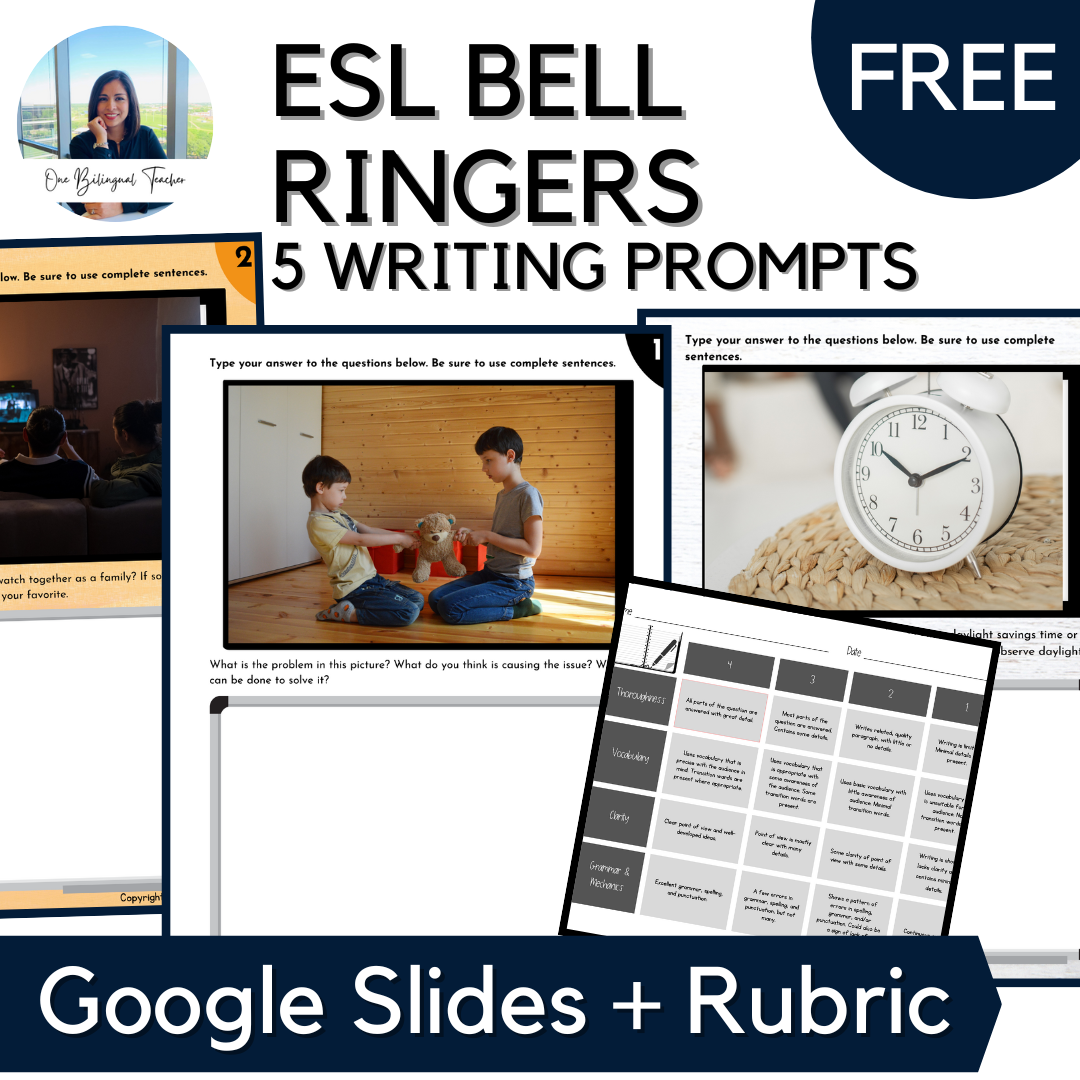
Picture prompts are one of the best tools I’ve ever used at the middle and high school level. The ones in my free writing picture prompts are five photographs of real situations that are relatable to middle and high school students, each paired with a prompt like “What’s going on here?” or “How could this problem be solved?”
Here’s how I used them: the prompt was on the screen when students walked in. They pulled out their notebooks and just started writing. Beginning students might write a few words. More advanced students might write half a page. No pressure either way. I also assigned them in Google Classroom so students could open their Chromebooks and write digitally. Same activity, different format.
What I love about picture prompts is that every student has something to say. The picture gives them the language they need to get started.
2. Personal narratives and life experience writing
As I said earlier, we can only write about what we know. And what your ESL students know is their own lives.
Assigning activities where students bring in their own experiences is one of the most powerful things you can do for ESL writers. These students have walked into an unfamiliar country, with unfamiliar people and an unfamiliar culture. What they’re holding onto is everything they left behind. Their families. Their food. Their friends. Their schools. Their language.
When you give them space to write about those things, it becomes almost sacred. It’s an opportunity for them to connect to the life they miss and love and that emotional investment makes them want to write. Personal narratives aren’t just a writing activity. They’re a bridge.
3. Sentence starters and writing frames
For students who are just beginning their English learning journey, a blank page is terrifying. Sentence starters and writing frames change that.
These scaffolds give students a structure to work within. They may already know the nouns — the people, places, and things they want to write about, but they don’t yet know how to string them into a sentence. A writing frame fills in those missing pieces. All they have to do is complete the thought.
When they’re done, they can read it out loud to themselves, or copy it onto a fresh piece of paper. That act of reading and rewriting their own words helps them internalize what a complete English sentence looks and sounds like. It’s not a shortcut. It’s a scaffold that builds toward independence over time.
4. Partner writing and peer editing
Some of my favorite moments in an ESL classroom came from partner writing.
I always paired students intentionally — one who needed more support with one who was slightly above their level. Before they wrote anything, they talked. They discussed the prompt, the picture, the concept. The stronger writer gave the emerging writer the words they needed. The emerging writer gave the stronger writer something to think about. They built ideas together.
Then they each wrote independently. You could always tell who was partnered with whom because the ideas were the same, but the writing was in each student’s own voice. That’s exactly what you want.
Rubrics are a natural extension of this. Students can use them to review each other’s writing, identify strengths, and suggest revisions. It builds editing skills alongside writing skills.
If you want structured partner writing activities that are already built for this kind of collaboration, my ESL Writing Bundle includes narrative, expository, argumentative, and descriptive writing activities designed for partners with a place for each student’s name and prompts meant to spark discussion before writing begins.

5. Daily low-stakes writing practice
Any chance you have to get students writing without the pressure of a grade, take it.
Bell ringers are perfect for this. Students walk in, they see a prompt, and they write — about what they did the day before, about a picture on the screen, about anything that gets their pen moving. It doesn’t have to be academic. It just has to be writing.
Exit tickets are another tool I love. Two or three sentences at the end of class about what they learned that day. Not only are they getting writing practice, they’re also synthesizing everything from the lesson. That’s two things at once.
Quick writes work the same way. A few minutes in the middle of class, a prompt, and they go. The regularity of it matters more than the length. Students who write a little every day become stronger writers than students who write a lot twice a semester.
6. Formal writing assignments
Formal writing has its place and don’t be afraid of it with ESL students.
Descriptive writing, personal narratives, expository essays, argumentative essays — these are the kinds of writing your students will be assessed on, and they deserve the opportunity to practice them. I actually love argumentative writing most of all. Students pick a side, do research, and defend their position. There’s something about having a strong opinion that makes ESL students want to write.
My approach is simple: I treat ESL students like students first and English language learners second. All students are kids before they’re anything else. So I approach formal writing the same way I would with any student and then I scaffold for the ESL learner.
The scaffolds matter. Graphic organizers help students organize their thoughts before they write a single sentence. Sentence frames help them structure their paragraphs once they’re ready to write. Class discussions give them ideas to draw from. And letting students know that their best is enough — that the standard is progress, not perfection — keeps them working instead of shutting down.
My ESL Writing Bundle covers all four of these writing types with materials designed to support the whole process from pre-writing through revision.
7. Reading response writing
One of the most natural ways to get students writing is to connect it directly to what they’ve just read.
I used to read novels in my class. More advanced students read independently. Students who weren’t yet at that reading level listened while I read aloud. Every day, no matter how we got through the text, there was a writing prompt about what we’d just read.
Students wrote first — independently, privately, in their own words. Then we came together to discuss. Because they’d already written their thoughts down, they knew exactly what they wanted to say. They weren’t scrambling for words. They were ready.
Those discussions got lively. The prompts were tied to themes and events that students had real feelings about, and once they’d written their thoughts, they were willing to defend them. Reading led to writing, and writing led to speaking. All three domains in one activity.
A final word
I’ve been teaching ESL for almost 20 years and I want to leave you with this.
Yes, there are tests. Yes, there are benchmarks and standards and data walls. But your students come to you with wildly different schooling experiences, different levels of literacy in their native languages, different amounts of time in the country. It would be impossible for any teacher to get every single student to pass every single test. This is not a reflection of your teaching.
What you can do every single day is believe in your students’ ability to grow. Celebrate every sentence. Celebrate every paragraph. Celebrate the student who went from writing nothing to writing three words, because that’s real progress.
Your best is enough. And so is theirs.
Ready to make writing less stressful in your ESL classroom? Grab my free Writing Picture Prompts, five real photographs with discussion prompts perfect for bell ringers, quick writes, or Google Classroom. No prep, no stress, just writing.
And if you want a full year’s worth of structured writing support across all four writing types, check out my ESL Writing Bundle in the store.
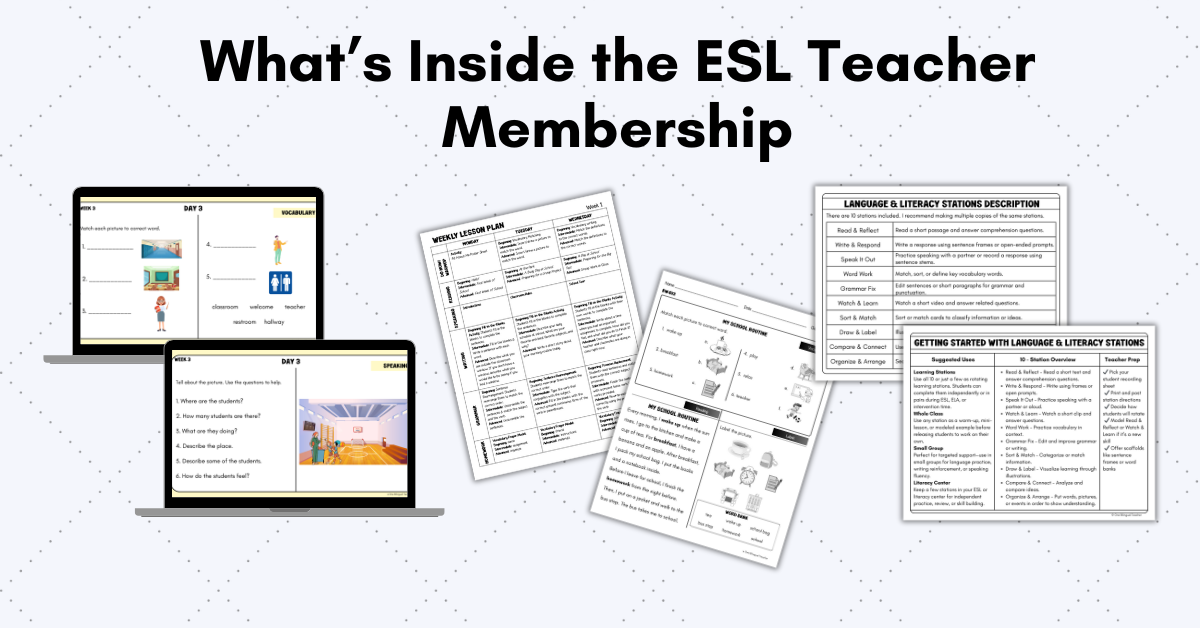
Ready for ready-to-use differentiated writing materials every month? Join The ESL Teacher Membership for secondary ESL teachers.