
Grammar Lessons for ESL Students: What to Teach and When
If you've ever stared at your lesson plans and thought, 'Am I even teaching grammar right?', you're not alone. It's one of the most common questions ESL teachers ask, and honestly, it's a hard one to answer. Because here's the truth: there is no perfect grammar sequence, no single checklist that works for every student, and no magic thirty-minute lesson that's going to make it all click.
I say this as someone who genuinely loves grammar. I love how language works. But as a former ESL student myself, I also know that grammar taught in isolation? It's a tough sell. My students didn't love grammar the way I did, and maybe yours don't either. That's okay. It doesn't mean we skip it. It just means we have to be smarter about how and when we teach it.
So let's talk about what grammar instruction actually looks like in a secondary ESL classroom, what's worth your time, and how to make it stick.
Why Grammar in Isolation Usually Doesn’t Work
Think about the last time you sat through a thirty-minute grammar lecture. How much of it did you retain? Now imagine being a teenager who's still figuring out English and someone is explaining direct objects to you in a language you're still learning.
Students don't learn language the way we sometimes teach it. They don't absorb grammar rules by labeling parts of speech on a worksheet. They learn by using language, hearing it, reading it, writing it, and getting feedback on it in real contexts. That's true for native speakers, and it's even more true for language learners.
I'm not saying grammar instruction has no place in your classroom. It absolutely does. But a full unit on nouns with no connection to reading or writing? That's two steps back for every one step forward. Students need to see grammar doing something. Making meaning, fixing confusion, helping them communicate.
What Grammar Should You Actually Teach?
The answer depends almost entirely on your students' proficiency level. Here's a simple way to think about it.
Beginners and Newcomers
If you're working with newcomers, skip the grammar labels for now. A newcomer does not need to know what an adverb clause is. They need to know how to say their name, ask for help, understand what's happening around them, and survive the school day.
What you can introduce at this level is basic sentence structure: subject, verb, what goes where. Students need to know how language works. That's what they're there for. And it doesn’t have to involve grammar rules. They just need to know how to communicate in sentences that actually make sense.
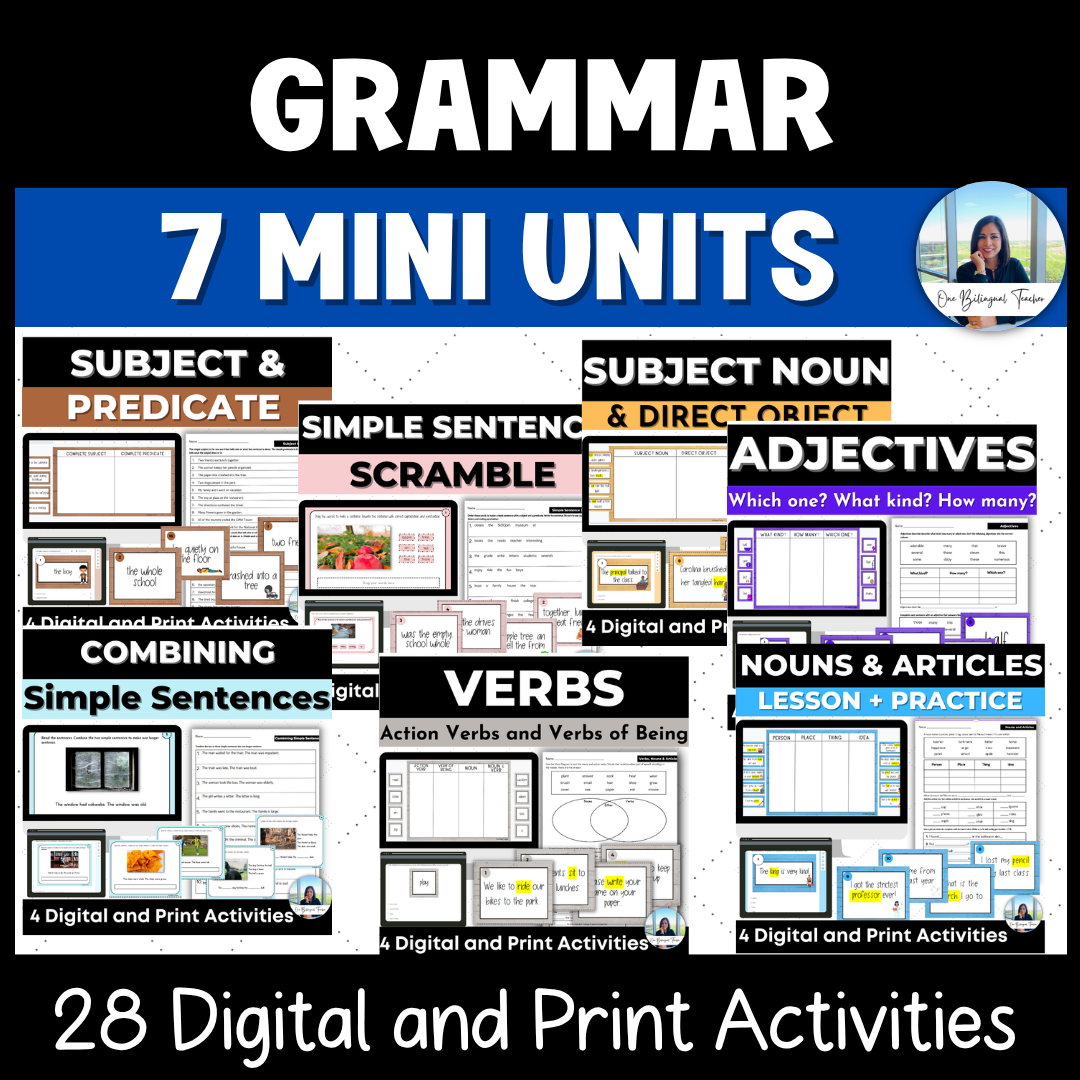
If you want some hands-on activities that work well at this level, the sorting and manipulative activities in my grammar resources are a good fit. Moving words around, grouping them, matching them — that kind of low-pressure activity works because students are interacting with language without having to produce it from scratch yet.
Intermediate Students
This is where grammar instruction starts to feel more purposeful, because intermediate students are writing, speaking, and making patterns of errors that you can actually see and address.
The most common issues you'll notice: mixed verb tenses, missing articles, and students pulling in words from their first language when they don't have the English word yet. (I did that myself in school. I'd be writing and hit a word I didn't know in English, so I'd draw a line and keep going. My teacher knew exactly what I meant and would fill it in. Don't let the missing word stop the writing. You can always go back.)
At this level, grammar instruction works best when it comes directly from what students are producing. Look at their writing. Where are the consistent errors? Start there. That's your grammar lesson. Not from a textbook sequence, but from what your actual students actually need.
Advanced Students
Advanced students are usually refining and tightening. They're working on more complex sentence structures, more precise word choice, and catching their own errors. This is where writing conferences become especially powerful, because students at this level can often self-correct when they slow down and read their writing out loud.
The Approach That Actually Works: Grammar in Context
The most effective grammar instruction I've done has never come from a grammar unit. It's come from looking at real writing, from real students, and working through it together.
Here's one activity I've used for years: I take a piece of student writing (with the name removed, always from a different class), put it on the screen, and we read it together. The class figures out what's working and what isn't. We fix it in real time, talking through the choices. No worksheet. No grammar rule in isolation. Just language, in context, being examined and improved.
This works for a few reasons. Students are engaged because it's real writing, not a textbook example. The mistakes are authentic, so the corrections feel meaningful. And when you fix a verb tense in context, students understand why. And it’s not just that the rule says so.
Writing conferences work the same way. I'll have a student read their own writing back to me out loud. Nine times out of ten, they catch their own mistakes while reading. When they don't, that's my opening. 'Your tense is off here, instead of saying it this way, try saying it like this.' It's targeted, it's immediate, and it's grounded in their actual work.
Daily Grammar Practice That Does not Feel Like Grammar
Daily Oral Language (DOL) exercises are worth mentioning here. Short, daily grammar practice where students look at a sentence with errors and correct them. It's one of the few times grammar in partial isolation can work, because it's brief, low-stakes, and becomes part of the routine.
Bell ringers that involve correcting or analyzing sentences serve the same purpose. They warm up language thinking without demanding a lot of output first thing. If you're looking for resources that work this way, check out my grammar resources or browse the full store for options that fit your level.
The other thing that teaches grammar better than almost anything else: reading. When students are immersed in English text, especially text at or slightly above their level, they're absorbing sentence structure, vocabulary, and language patterns without ever opening a grammar workbook. Wide reading is one of the most underused tools in ESL instruction.
A Rough Sequence to Follow
If you're feeling like you need a starting point, here's a loose sequence that makes sense for most secondary ESL classrooms:
Basic sentence structure (subject + verb, how English sentences are built)
Parts of speech — lightly, as labels that help, not as the focus
Verb tenses — present, past, and future first, then more complex forms as students are ready
Error patterns from student writing — this becomes your ongoing, living grammar curriculum
That last one is the most important. Your students' writing will tell you exactly what to teach next. You don't have to guess, and you don't have to follow a scope and sequence that was never designed for your specific students.
Be Patient With Yourself and Your Students
Grammar is hard to learn. It's hard to teach. And most students, especially teenagers, are not sitting in your class thinking, 'I really hope we do a grammar lesson today.' They're trying to function in the world. They want to talk to their friends, understand their teachers, write something that makes sense. Grammar is a tool that helps them do that. When we teach it that way, they are more open to learning it.
If you've been drilling grammar worksheets and wondering why it's not sticking, that's not a reflection of your teaching. Grammar divorced from meaning is hard for anyone to retain. The shift is toward using grammar instruction to serve communication, not the other way around.
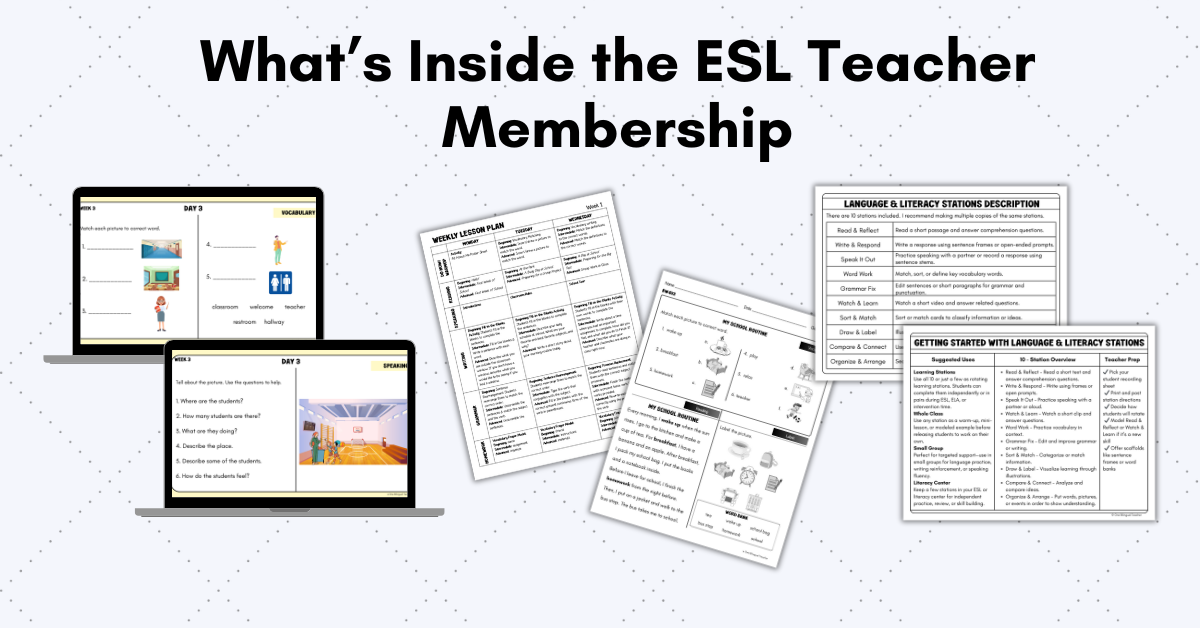
If you want more support with how to actually structure your ESL instruction, The ESL Teacher Membership is where I go deeper on all of this — including curriculum when you have mixed levels, newcomers, and no dedicated ESL materials. You can also find ready-to-use grammar resources in my store if you need something you can use this week.
And if you want to talk through what's happening in your classroom with other secondary ESL teachers, come join us in the Facebook group. It's a good place to ask questions and see what's working for others.
Grammar doesn't have to be the part of ESL instruction that feels impossible. Start with your students, look at their writing, and teach what they actually need. That's really all there is to it.