

How to Make Test Prep a Year-Round Habit in Your Secondary ESL Classroom

You know that feeling when testing season hits and you suddenly realize your students have not practiced the skills that will actually be on the test?
So you scramble. You pull things together. And you hope for the best.
It doesn’t have to go that way.
ESL test prep does not have to be a separate, stressful thing you do in the spring. It can be something your students practice consistently all year in small doses, so by the time testing season arrives, they are already ready.
Here is how to make it happen.
Why ESL Students Struggle With Reading Tests (And It Is Not What You Think)
A lot of ESL students can understand a passage just fine and still miss the question.
The content is not always the problem. The language of the question is.
Words like main idea, central idea, inference, text evidence, drawing conclusions are not everyday words. So when ELL students see them on a test, they freeze. They understood the reading. They just didn’t understand what was being asked.
That’s an exposure problem. And it’s completely fixable.
When students practice these question types consistently throughout the year, the academic vocabulary becomes familiar before test day instead of during it. That’s the whole foundation of effective ESL test prep for middle and high school students.
This is why using differentiated ESL activities makes such a big difference for mixed-level classes.
Start With ESL Bell Ringers
Bell ringers are one of the easiest ways to build consistent test prep practice into your secondary ESL classroom without disrupting your regular lessons.
The idea is simple. Students walk in, read a short passage, and answer one question. You review it together as a class. The whole thing takes about 5 minutes.
That’s it.
Over time, ESL students start recognizing the language used in test questions. They stop second-guessing themselves. They start answering with confidence.
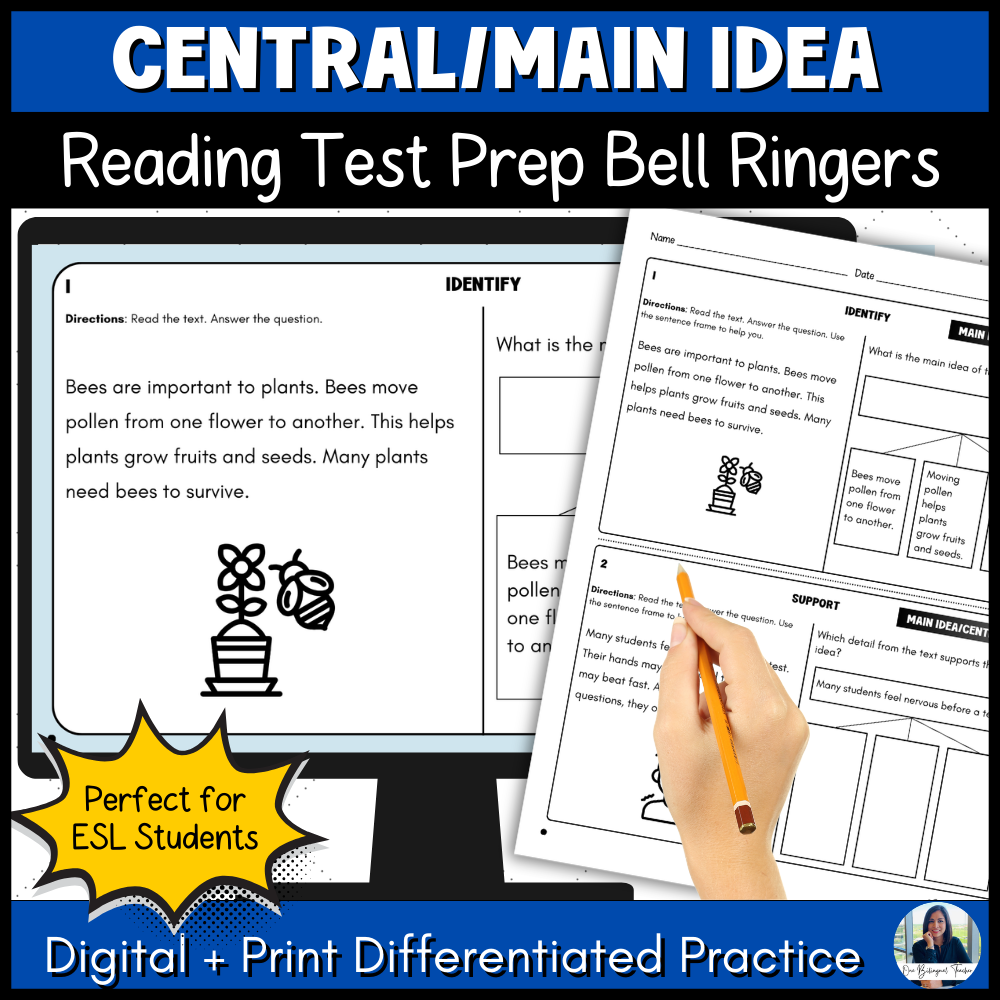
If you want to try this with your class, I have a free set of Main Idea/Central Idea Bell Ringers made specifically for ESL students. They come in beginning, intermediate, and advanced levels and in both print and Google Slides formats so you can use them however works best in your classroom.
Cover the Big Reading Skills All Year Long
Main idea is just the start. There are six reading skills that show up on most standardized tests for ELL students:
Main Idea / Central Idea
Supporting Details
Summarizing
Text Evidence
Inference
Drawing Conclusions
If you can weave consistent practice with each of these skills into your school year, your students will walk into testing season having already seen every question type before. That’s what makes ESL test prep actually work: familiarity, not cramming.
You do not have to do all six at once. Spend a few weeks on one skill, then move to the next. Use bell ringers, warm-ups, or exit tickets, whatever fits your routine.
The key is consistency, not intensity.
Differentiate From Day One
Your ESL students are not all at the same level.
A beginning ELL student and an advanced ELL student are not ready for the same passage or the same question format. So if you hand everyone the same worksheet, half the class is lost and the other half is bored.
Effective ESL test prep has to be differentiated. That means beginning, intermediate, and advanced versions of the same skill so every student is practicing at the right level and building toward the same goal.
That’s exactly how these resources are designed.
Ready-to-Use Resources That Cover All Six Skills
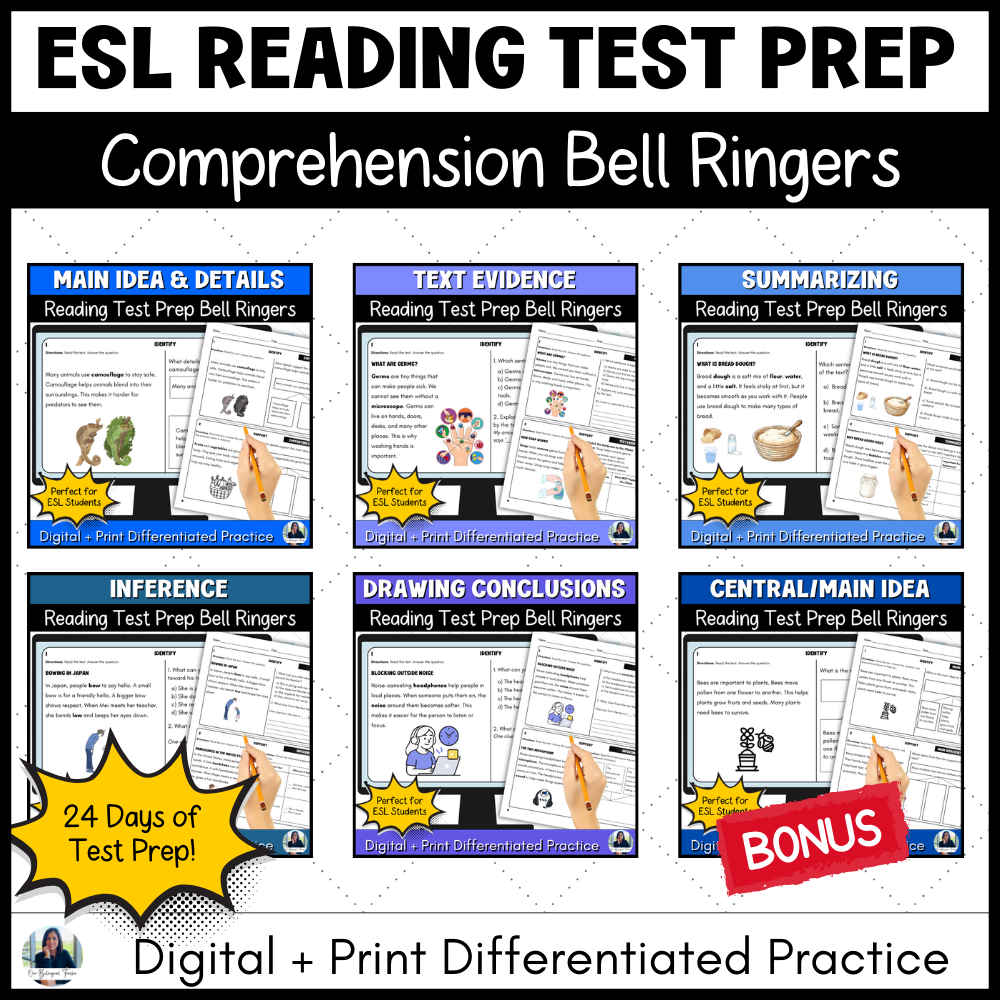
If you want to skip the prep work and have everything ready to go, I put together a Test Prep Differentiated Bell Ringers Bundle that covers all six reading skills: Main Idea, Supporting Details, Summarizing, Text Evidence, Inference, and Drawing Conclusions.
Each skill set includes:
4 days of activities
Beginning, intermediate, and advanced versions
Print and Google Slides formats
So instead of piecing together ESL test prep activities from five different places, you have everything in one spot, ready to use Monday morning.
➡️ Grab the Test Prep Bundle here
The Bottom Line
Your ESL students do not need a test prep marathon in March. They need small, consistent practice all year long.
Start with one skill. Use a bell ringer. Review it together. Move on.
Do that a few times a week and by the time testing season arrives, your students will already know exactly what to do.